Tuesday, August 31, 2010
Fledglings
Sunday, August 29, 2010
Babies!
Friday, August 27, 2010
Mourning Doves

Thank you, Robin, for correctly identifying our porch birds, especially from those small photos on my blog. It always impresses me when people can do that! I've done my internet research and found out some interesting facts about mourning doves, so I am sharing them with you here. Most of the information is from the Cornell University website called "NestWatch".
1. They are monogamous and mate for life. (For better, for worse, for richer, for poorer...just like Joe and I.)
2. The father sits on the nest during the day, and the mother through the night. So it's usually the father that we see during the day. One parent bird is always with the hatchlings. Sounds extremely nurturing and sensible. I especially like that the fathers do 50% of the childcare.
3. They are a common species and live all over our continent (so you probably have one or two around your own front porch. Hang a few baskets and see what happens.)
4. Their flight is fast and bullet straight. But they eat seed off the ground which makes them vulnerable to cats and other predators. Wisely, they prefer to build their nests off the ground.
5. Their soft drawn out coos sound like laments, hence their name. It sounds like "woo-OO-oo-oo".
6. The chicks are cared for by their parents in the nest for 25-27 days. So we figure they will be here for about three more weeks.
7. The chicks will fledge (get their flying feathers ) 15 days after hatching. Perhaps one more week till that happens. They are soft little balls of gray down right now.
8. Their nests are flimsy platforms of twigs and sticks, and they lay two eggs at a time. I had seen a loose nest in the basket, but figured it was from early summer and the birds were long gone. Not so. They re-used their own previously built nest. Recyclers.
9. They have two or three nests a season. That explains the late summer nest, and also them being here all summer long. And they may be back next year. Once they find a spot, they stick to it. Next time, I'll be paying attention.
10. Due to its frequent breeding, and wide range across the continent, "Zenaida Macroura" is not considered an endangered species. Oh good. I can relax.
Luke 12:6
Monday, August 23, 2010
On Our Front Porch
Thursday, August 19, 2010
Thursday, August 12, 2010
Mourning Another Birthday
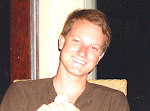
Joseph Neal Johnson 8/17/79-5/22/08

I miss you, beautiful son.
Miss your presence here with us.
Miss your warmth and humor, your enthusiasm for life, your insight and interested mind.
I miss getting hugged by you. Tall tender hugs. No one hugs me like that anymore.
I loved being your mother. I felt so proud of you. I loved your vibrance--that red hair and those deep brown eyes and the radiant, ever-ready smile.
I miss the closeness we all felt with you, and the way you enjoyed being with us.
I miss traveling with you, meeting up at the airport someplace, and exploring the world through your lively commentary and alert eyes.
I miss my cultural guide, and your efforts to keep me properly informed.
You, my son with an opinion on everything, also listened.
I loved our talks.
Playing music with your dad, or talking investment schemes. Laughing with your sisters and brother-in-laws. Entertaining your beloved nieces and nephews. Surfing, eating, traveling with Rachel. Rushing at life with Kevin and JR and Theo and Josh and so many others. And music.
Your life was rich with the sound of melodies
rising up.
Your voice --a song.
Cut short.
I can hardly wait to open the door one day and find you standing there.
Radiant and alive.
I miss you so, beautiful son.
For God loved the world so much that he gave his one and only Son, so that everyone who believes in him will not perish but have eternal life.
John 3:16
Monday, August 02, 2010
Pushing Forward

I have found new solace in a reminder from Rick Warren's book The Purpose-Driven Life. He gives a quick summary of life by simply saying, "life is a test, a trust and a temporary assignment". Easy to say, easy to remember, easy to mentally grab when I'm at a loss for direction. Basic. Helpful. Anchoring. Comforting.
The "test" part is easy enough to see. For me, right now, the test is whether or not I will trust the God who has declared His love for me, even though I walk a dark valley. Or will I only trust Him on the sunny days, when the cupboards are full and the car doesn't break down? In my heart and in my will, after the loss of Joey, I've re-made a decision to trust His good character. I believe Him when He says all things will ultimately work together for good. I've released my expectations of what He has to do for me in this life. I'm counting on Him showing me someday, detail by detail, how He wove my sad story into a bigger, more beautiful story of redemption. I'm trusting Him to turn my water into wine.
The "trust" part of my purpose-driven life is a little more complicated. It means I've been entrusted to do something good with the bad in my life. I can trust God to do good with bad, but can He trust me? Can the people around me trust me? Will I show them a way through suffering and loss that's honest but also hopeful? Will my life story kill their faith and joy, or will it build it? Will I leave them unsure, unstable and doubting, or will my story reassure them that their faith in God can carry them through whatever losses and trials life brings them? That's where I live right now. I still have more questions than answers, but I know what I'm wishing for. I'm reaching for hope, for the sake of my grandchildren, and my daughters, and anyone else who may be watching me. That is the engine that gets me out of bed when the clock strikes 7 am and I start another day of living by faith in the midst of crucial, unyielding disappointment.
The fact that life is a temporary assignment helps. That's the most comforting part of Warren's three-part equation. I couldn't live with an eternity of loss and grief, but I can live with a season of it. God was indeed merciful to make the average human lifespan short enough that we could get to the end of it, make the cross over, and then, after all that, find everything we'd ever been longing for on the other side of it. (Need I mention that this only inspires gratitude when it's not your child whose lifespan is short?)
I am thankful for the statistical brevity of my own numbered days. I feel I can make the journey. However difficult my days are here, I am certain there's something so very good waiting for me on the other side, and that gives me strength to bear the burdens of this life. In this moment, my work is unfinished. There are tasks and lessons and people with which I have been entrusted. I don't have a big, impressive plan, (wish I did) but I do want to sort it out and live the truth and give it my best. I do want to finish well.
And so, I push forward.
Philippians 3:14
I press on toward the goal to win the prize for which God has called me heavenward in Christ Jesus.
Friday, July 30, 2010
Mid-Summer Grandchild Update
Thursday, July 29, 2010
SUDEP in the New York Times
Unmasking Silent Killer in Epilepsy
The New York Times
By ALIYAH BARUCHIN
Published: July 26, 2010
On July 9, 2009, Steve Wulchin went to wake his 19-year-old son, Eric, in their home in Boulder, Colo. Eric had been given a diagnosis of epilepsy three years earlier, but other than that, his father said, "there was nothing out of the ordinary." His seizures had been well controlled; he had not had one in six months.
Yet that morning, Mr. Wulchin found Eric lying on the floor. CPR and paramedics were too late; Eric had died at about 2:30 a.m.
The cause of Eric's death was ultimately listed as Sudep, for sudden unexplained death in epilepsy. The syndrome accounts for up to 18 percent of all deaths in people with epilepsy, by most estimates; those with poorly controlled seizures have an almost 1 in 10 chance of dying over the course of a decade.
Yet many patients and their families never hear about Sudep until someone dies. Mr. Wulchin said none of Eric's four neurologists ever mentioned it to the family.
"The message we got back was, 'There's no reason why he can't live a long and normal life,' " he said. "It never occurred to me that this was a possibility."
Now, physicians, researchers, advocates and relatives like Mr. Wulchin, a technology executive, are trying to raise awareness about Sudep. One of their goals is to establish registries of deaths and autopsy results, building databases to support future research.
Sudep most often affects young adults, typically ages 20 to 40, with a history of the convulsive seizures once known as "grand mal." Others at risk include those with difficult-to-control seizures, or seizures at night; people who take a large number of anti-epileptic medications or take them irregularly; African-Americans with epilepsy; and people with epilepsy whose I.Q. is under 70.
Many victims die in their sleep, and their bodies are often found face down. That prone position suggests that they may have had a neural, respiratory or cardiac crisis - or some combination - that left them momentarily unable, like SIDS babies, to rescue themselves from suffocating.
"After a seizure, the person is in a dramatically reduced state of awareness, and even their reflexes are reduced," said Dr. Orrin Devinsky, director of the Comprehensive Epilepsy Center at New York University.
For most people, he went on, "once your airway's obstructed, you roll over. For people with epilepsy, they don't."
Epilepsy, wrapped for centuries in secrecy and stigma, has gained wide attention in recent years. Not so with Sudep; even neurologists who specialize in epilepsy sometimes feel that mentioning it to patients who aren't at high risk may impose too much of a burden.
"Whenever I speak to a group of colleagues about telling all their patients, it's controversial," said Dr. Elizabeth Donner, a neurologist at the Hospital for Sick Children in Toronto and co-founder of the advocacy group Sudep Aware. "People worry about having a negative impact on the quality of life of people with epilepsy if we tell them about this."
Mr. Wulchin and other advocates say this attitude needs to change, even in the absence of a concrete way to predict or prevent a sudden death.
"People go off and have babies knowing very well that SIDS could strike," he said. "People have surgery and they get the standard warning that there could be adverse reactions to the anesthesia to the point of a fatality. We deal with these kinds of ambiguities all the time."
Dr. Donner agrees. "People with epilepsy have the right to know that Sudep exists, and they have the right to be responsibly counseled about how to reduce the risk," she said. "And actually, that doesn't have to be a painful conversation."
Dr. Devinsky, at N.Y.U., says he often directs at-risk patients to Britain, which has been at the forefront of Sudep awareness. There, devices like mattress alarms and structured pillows are sold to protect against death in sleep.
But just as research into epilepsy has been hindered by stigma, experts and advocates say the silence about Sudep is making it difficult to explore causes and treatments.
"I think this needs to be part of our conversation," said Gardiner Lapham of Washington, D.C., a board member of the advocacy group Citizens United for Research in Epilepsy, whose son, Henry, died in 2008, at age 4. "The more people talk about it, the more people are going to be interested in getting to the causes of why this is occurring, and ultimately identifying ways to prevent it."
Last year, researchers at Baylor Medical College in Houston, led by Dr. Jeffrey Noebels, discovered that a genetic mutation linked to a type of irregular heart rhythm called Long QT syndrome could also lead to seizures - suggesting that Sudep may result from electrical disruptions occurring in the brain and heart together. And this spring, the team isolated a mutation on a different gene that may cause seizure activity in the brain to direct extra impulses through the vagus nerve to the heart, making it slow and, in some cases, stop beating.
Saturday, July 24, 2010
Greg Laurie's Grief

Pastor Greg Laurie lost his son, Christopher, (on the right in the photo) two months after we lost Joey. Today is the anniversary of that day and the words below are taken from his facebook page today. He speaks for every bereaved parent in his words and so I wanted to share them.
We have been deeply comforted by him many times in the past two years. I am so sorry for his loss, yet so grateful that we've walked this road together. I don't know him personally, though I have heard him speak a couple of times at the Harvest Crusade in Honolulu. He is wildly popular, with 40,000 friends on facebook, and a gifted evangelist, drawing huge stadium crowds every summer, all over the country. He is the aging Billy Graham's heir apparent, and in the real world they are very good friends. I do know that he has been an anchor for us in the two years since Joey went to Heaven. He has always been an anointed preacher/teacher, but now even more so because he has increased credibility through his suffering. I highly recommend his blog and facebook page and that of his wife, Cathe Laurie. They always have inspiring things to say.
So with that introduction, I share these honest, heartfelt words from a grieving father with you.
"At first, people would approach with often clumsy attempts at offering sympathy. Other times, they would say just the right thing.
But after two years,very few people say anything at all. Only a handful. Perhaps they don’t know what to say.
Many will ask how a grieving person is doing. Are they over it yet? May I answer for all people who have lost loved ones, especially children?
No. We never will be “over it,” so please don’t ask that, if you please.
Some well-meaning but misguided Christians might say, “Don’t be sad. They are in heaven!” You must have never lost a loved if you say something like that. We know they are in heaven, and frankly, we want them here with us on Earth. So, we are sad.
When the apostle Paul’s friend and fellow worker Epaphroditus fell gravely ill, Paul wrote in a letter: “Indeed he was ill, and almost died. But God had mercy on him, and not on him only but also on me, to spare me sorrow upon sorrow” (Philippians 2:27 NIV).
So even Paul, who certainly had a strong faith and his theology straight, could hardly bear the thought of being separated from a close friend by death.
Are we getting through it?
The answer to that question is yes. Some days are better than others.
The most random things can trigger vivid memories that we did not even know were stored in the vaults of our imaginations. But like little home movies, they play out, and it both comforts and saddens.
But the thing we cannot do is forget. Nor do we want to, even if remembering causes pain.
Yes, our pain is deep, but know this: God is deeper still. He has kept His promises to me and my family. He has been there for us each step of the way, though it has been so very hard.
So we do not sorrow as those who have no hope. But we do sorrow. And we will continue to shed many tears. That’s because our love continues on for that person that has left us."
Thursday, July 22, 2010
Our New Sidewalk
Wednesday, July 14, 2010
Words to Live By
His writing is mostly funny, but now it's become poignant. His list of what he was thankful for on his last Thanksgiving, an April Fool's Day gag in which he told us that he was going to sail around the world, his emails on his last day of his earthly life--all of them are packed with new meaning for us now. In one email he told a friend that his mother (me) always believed him and that it made him feel good. It made me feel all warm inside to simply read those feelings that I hadn't known. In most of his snippets he is expressing affection to friends or family. He poured out a lot of love on people through his words and that is a gift that keeps on giving as we re-visit those words.
So I'm starting a new project. I am gathering up his words and putting them in a scrapbook. I plan to include pictures of the people, places and things about which he wrote. That way, on those days when the missing is so intense, we can pull it out and "hear" him speak to us again.
Proverbs 12:18
Reckless words pierce like a sword, but the tongue of the wise brings healing.
Thursday, July 08, 2010
Monday, July 05, 2010
The Light Show
Sunday, July 04, 2010
Beach Beefcake!
Grandson and friends on bikini patrol.(Not Papa--he's occupied on his droid)
Happy 4th of July!

"freedom of speech, freedom of religion, freedom of assembly"--all in one little package below me.